Why ban glyphosate?
We hope you enjoy this free article from OrganicNZ. Join us for access to exclusive members-only content.
Glyphosate is the active ingredient in Monsanto’s herbicide Roundup, and other proprietary brands by Bayer, Dow, Zeneca, Nufarm and others.
It is the most used herbicide worldwide in agriculture, horticulture, viticulture, forestry, industrial and public sites, aquatic environments, gardens, sports and school grounds. A US patent even covers in vivo use for animals or humans as an antibiotic treatment of pathogenic infections.
Such widespread use provides uncountable exposure pathways, and concerns about the effects of glyphosate are increasingly raised.
More than the ‘active’ ingredient
In tests of active and added ingredients in nine pesticides, glyphosate was found the most toxic, challenging ‘the relevance of the acceptable daily intake for pesticides because this norm is calculated from the toxicity of the active principle alone’.[1]
Glyphosate is not included in compounds tested by the US FDA’s Pesticide Residue Monitoring Program or the USDA’s Pesticide Data Program and, in assessing safety, the cumulative effects of approved levels on the human or physical environment are not taken into account.
Environmental effects
Glyphosate-resistant and other transgenes have transferred to weeds and non-transgenic crops. Glyphosate-resistant weeds exist in 18 countries, with significant impacts in the USA, Brazil, Australia, Argentina and Paraguay. In the American South, 86% of corn, soy and cotton farmers are affected by herbicide-resistant weeds. Resistance has been identified in some New Zealand locations, attributed to ‘over application’ of the herbicide.[2]
Glyphosate is a chelator of minerals; it combines with other minerals to make them available only under certain conditions. In plants, root uptake and shoot translocation of manganese and iron are severely depressed by glyphosate applications.[3],[4]Copper adsorption decreases in general with increasing concentration of glyphosate in solution.[5]Glyphosate also reduces seed and leaf concentrations of calcium, manganese, magnesium, and iron in non-glyphosate-resistant soybeans,[6]decreases in seed concentration being specific and potentially affecting seed quality.[7]
Glyphosate’s median half-life in soil is between two and 197 days, depending on soil and climate conditions, and can reach 1699 days under anaerobic conditions. Its median half-life can reach 91 days in water.[8] It adsorbs to suspended soil particles, and is not readily broken down by water or sunlight in surface water.[9],[10]
Denmark has banned autumn spraying of glyphosate where it contaminates groundwater to five times over the allowed limit and where it is a source of drinking water.[11]
Pesticide Action Network Asia Pacific says of greatest concern are the effects ‘that occur at a subtle level, and can result in significant disruption of aquatic and terrestrial eco-systems, including the agro-ecosystem’.[12]
Human health effects
An estimated 90% of transgenic crops grown globally are engineered to be glyphosate-resistant. In 2012, they accounted for45.2% of the total glyphosate demand. Glyphosate-resistant canola/rapeseed, corn/maize, cottonseed, soybeans and sugar beet provide common ingredients in a huge range of food products. Transgenic soy alone represents 77% of global soy production.
The only known peer-reviewed study on human volunteers ingesting transgenic DNA revealed detectable levels in the gut bacteria of participants.[13]For two decades, US citizens in particular have ingested multiple unlabelled transgenes every day. Medical professionals in the US point to this fact to help explain the huge rise in chronic diseases since the release of commercial transgenic crops.
Evidence is mounting that glyphosate interferes with many metabolic processes in plants and animals, and glyphosate residues have been detected in both. Correlation analyses of official statistics revealed strong significance of the effects of glyphosate and transgenic crops on human health.[14]
Negative impacts of transgene ingestion can manifest slowly over time by damaging cellular systems, including oxidative stress, endocrine disruption as general mechanisms of harm that result in insidious effects. A 2002 paper on the effect on cell cycle regulation of glyphosate-containing Roundup concluded: ‘results question the safety of glyphosate and Roundup on human health’.[15]
A 2009 study concluded that glyphosate-based herbicides ‘present DNA damages and CMR [carcinogenic/mutagenic/reprotoxic] effects on human cells and in vivo.[16]Even at very low doses, exposure to glyphosate-based herbicides may result in reproductive and hormonal problems, miscarriages, low birth weights, pre-term deliveries, and birth defects.
Accumulating through the food chain
Urine samples taken from 182 participants in 18 European countries revealed glyphosate in 43.9% of the samples.[17]Breast milk samples given by lactating mothers revealed glyphosate levels of 76–166 micrograms per litre (µg/l), which is 760–1600 times higher than the European Drinking Water Directive allows for individual pesticides, but less than the 700 µg/l maximum contaminant level allowed by the US EPA based on the premise that glyphosate is not bioaccumulative.[18]
Animal feed imported into New Zealand frequently contains ingredients from glyphosate-resistant crops, resulting in the bioaccumulation of glyphosate and/or glyphosate metabolites in feeding animals, adding to the human end-user intake.
All animals, including humans, bioaccumulate nutrients, and can bioaccumulate substances in the body to levels that can cause harm. A typical food chain bioaccumulation process is plant uptake from soil or spray, animal eating plant, human eating animal. Each step can result in increased bioaccumulation including toxins where absorption of a substance is at a rate greater than that at which the substance is lost or eliminated. One study concluded that animals and humans eating transgenic soy ‘chronically incorporate unknown amounts of this herbicide’.[19]
Novel proteins, increased allergens
Introducing novel DNA into a plant’s genome can result in the production of proteins new to the human diet, and increasing levels of existing, known allergenic proteins, e.g. lectins and trypsin inhibitors in transgenic soy. The more transgenic plants are present in the food chain, the more potential for consuming proteins new to a diet.
Allergic reactions to these proteins may not reveal themselves immediately. Many symptoms identified in a study into allergic reactions to glyphosate-resistant soy may be related to glyphosate exposure, e.g. irritable bowel syndrome, digestion problems, chronic fatigue, headaches, lethargy, and skin complaints.[20]
Why we need a ban
Two decades after the introduction of genetically engineered crops, there remains no official monitoring of the consequences to the human population ingesting resistant transgenes and/or glyphosate-based herbicides (which are used on 80% of the GE crops worldwide), and consumers have no official notification of risks.
From pre-emergence to pre-harvest, glyphosate is applied to food crops. Almost every non-organic processed food item in the supermarket or on a menu is likely to be contaminated by glyphosate in some way.
Authorities need to apply the precautionary principle and ban the use of glyphosate.
Doctors and scientists say: ban glyphosate
Read why Physicians and Scientists for Global Responsibility are calling for a ban on glyphosate:www.psgr.org.nz/glyphosate-calling-for-a-ban/finish/8-uncategorised/25-glyphosate-calling-for-a-ban
REFERENCES
[1]Mesnages, R et al. 2014. Major pesticides are more toxic to human cells than their declared active principles. BioMed Research International. www.hindawi.com/journals/bmri/aip/179691
[3]Eker, S. 2008. Foliar-applied glyphosate substantially reduced uptake and transport of iron and manganese in sunflower (Helianthus annuus L.) plants. J Agric Food Chem. 54(26).www.ncbi.nlm.nih.gov/pubmed/17177536. Tesfamariam, T et al. 2009. Glyphosate in the rhizosphere: Role of waiting times and different glyphosate binding forms in soils for phytotoxicity to non-target plants. European Journal of Agronomy, 31.
[5]Jayasumana, C et al. 2014. Glyphosate, hard water and nephrotoxic metals: are they the culprits behind the epidemic of chronic kidney disease of unknown etiology in Sri Lanka? Int J Environ Res Public Health.www.sciencedirect.com/science/article/pii/S0045653501003381.
[6]Cakmak, I et al. 2009.Glyphosate reduced seed and leaf concentrations of calcium, manganese, magnesium, and iron in non-glyphosate resistant soybean. European J Agronomy. 31(3).www.sciencedirect.com/science/article/pii/S1161030109000665
[7]research.sabanciuniv.edu/13147/1/2009_Glyphosate_reduced_seed_and_leaf_concentrations_of_calcium_etc.pdf
[10]“Registration Decision Fact Sheet for Glyphosate (EPA-738-F-93-011)” 1993.
[11]Politiken. organic.com.au/news/2003.09.15
[12]Watts MA. 2009. Glyphosate Monograph. Pesticide Action Network Asia and the Pacific, Penang.www.panap.net/sites/default/files/monograph_glyphosate.pdf,
[13]Trudy Netherwood et al. 2004. Assessing the survival of transgenic plant DNA in the human gastrointestinal tract.Nature Biotechnology22. www.nature.com/nbt/journal/v22/n2/full/nbt934.html
[14]Swanson, Net al. 2014. Genetically engineered crops, glyphosate and the deterioration of health in the United States of America. Journal of Organic Systems, 9(2), 2014. www.organic-systems.org/journal/92/JOS_Volume-9_Number-2_Nov_2014-Swanson-et-al.pdf
[15]Marc J et al. 2002. Pesticide Roundup provokes cell division dysfunction at the level of CDK1/cyclin B activation.
Chem Res Toxicol. 15(3). www.ncbi.nlm.nih.gov/pubmed/11896679.
[16]Gasnier, C et al. 2009. Glyphosate-based herbicides are toxic and endocrine disruptors in human cell lines. Toxicology 262.
www.gmoseralini.org/wp-content/uploads/2013/01/Gasnieral.TOX_2009.pdf
[19]Kruger, M et al. 2014. Detection of glyphosate residues in animals and humans. Journal of Environmental and Analytical Toxicology 4:210.dx.doi.org/10.4172/2161-0525.1000210
[20]Jeffrey Smith. 2007.Genetically engineered foods may cause rising food allergies: Genetically engineered soybeans. institute for responsible technology. www.responsibletechnology.org/gmo-dangers/health-risks/articles-about-risks-by-jeffrey-smith/Genetically-Engineered-Foods-May-Cause-Rising-Food-Allergies-Genetically-Engineered-Soybeans-May-2007
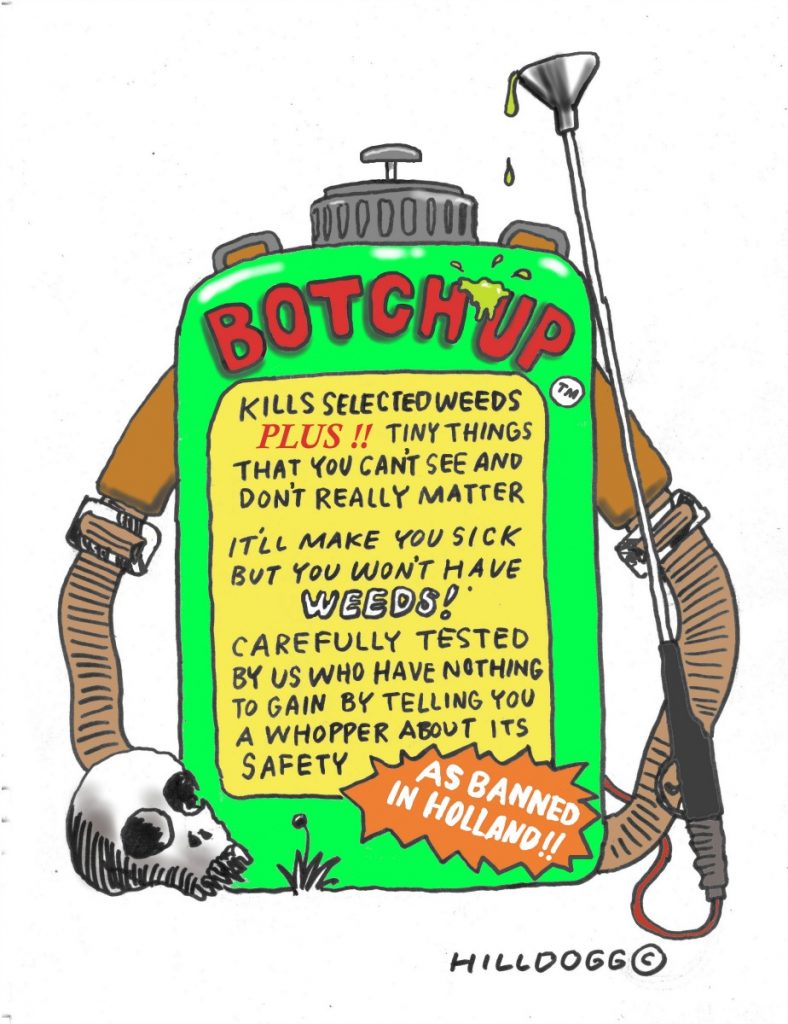
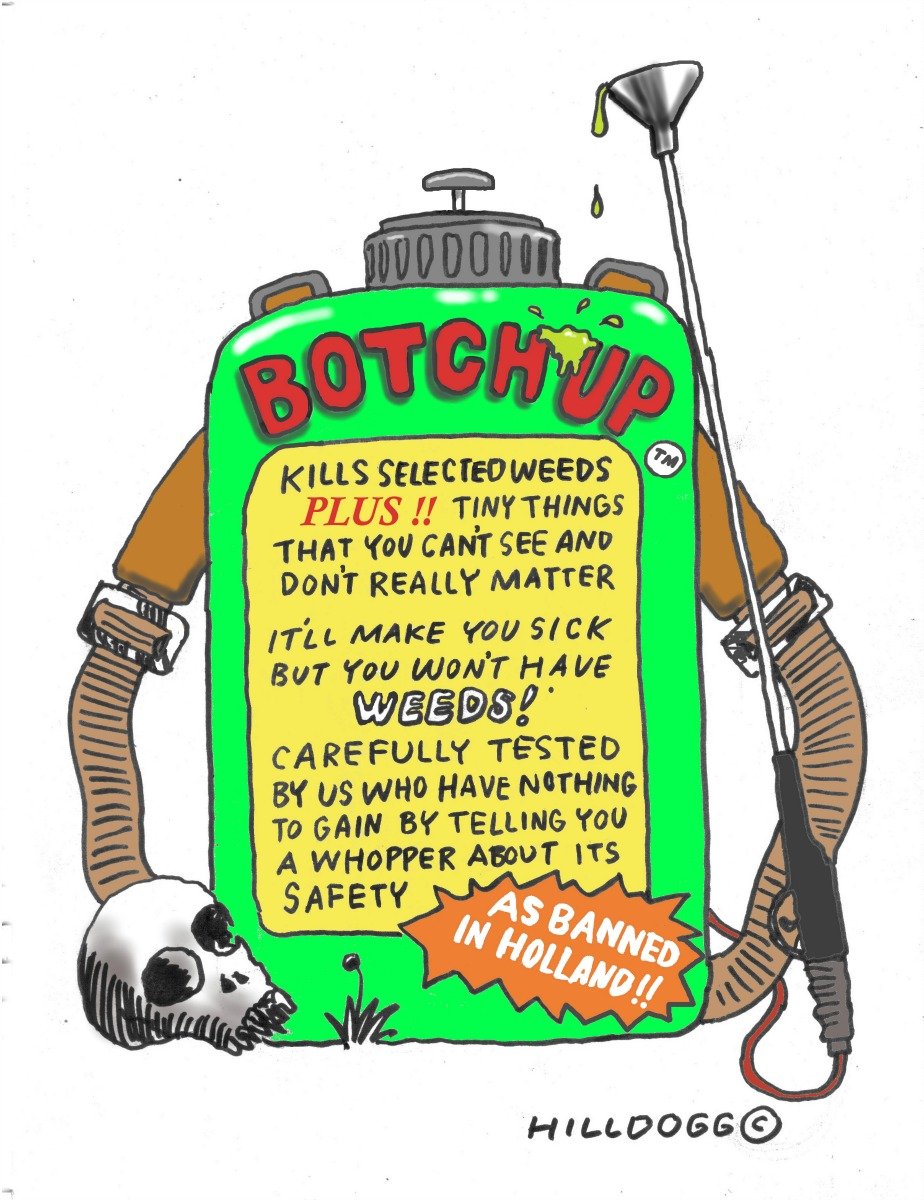
Illustration: Duncan Hill, http://hilldogg-visionary.blogspot.com