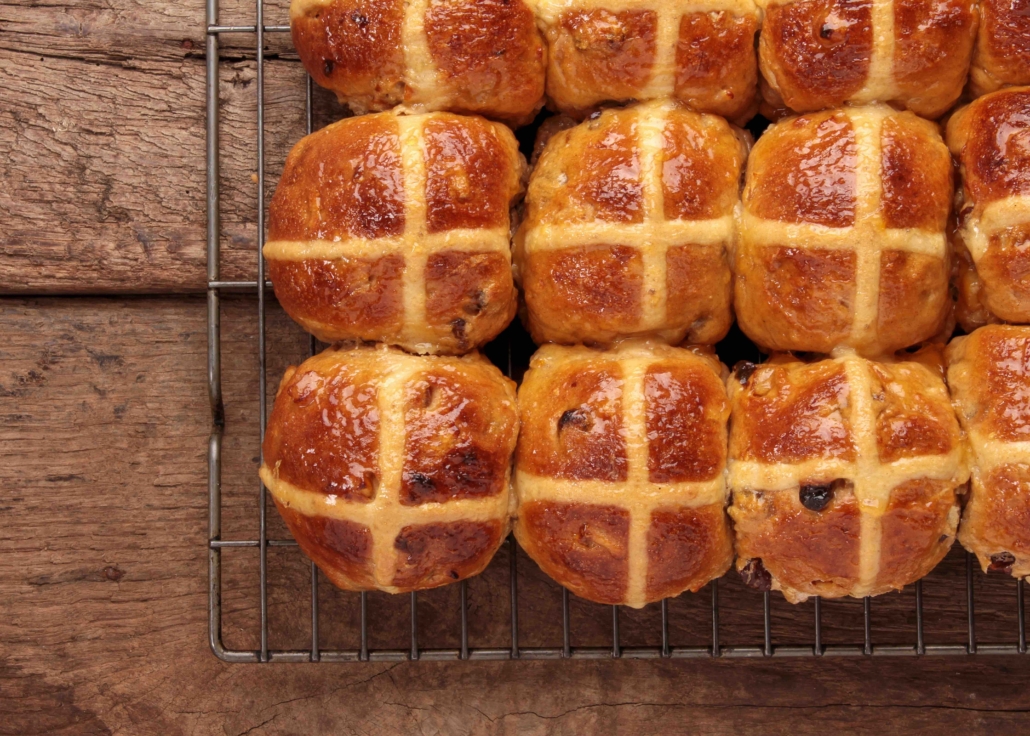
Hot cross buns
By Isabel Pasch
Enriched and decorated breads are a European Easter tradition that dates back thousands of years. Easter was the festival held at the (northern hemisphere) spring equinox in celebration of the Germanic goddess Eostre, the goddess of dawn. It was the end of the long winter fast. The Christian version was really just a takeover of this festivity.
In Europe, enriched and braided brioche breads grace Easter breakfast tables. In Britain, spiced and fruit-enriched hot cross buns became the popular national treat.
Recipe first published in Organic NZ, March/April 2021
We hope you enjoy this free article from OrganicNZ. Join us to access more, exclusive member-only content
Equipment needed
- 1 baking tray or 1 approx. 24 cm square or round cake tin
- Kitchen Aid (optional)
- Piping bag with fine tip, or plastic freezer bag
- 1 large mixing bowl
Ingredients (makes 10–12 hot cross buns)
- 750 g strong bread flour
- 400 ml milk
- 1 egg
- 150 g unsalted butter
- 150 g golden sugar
- 1 tsp vanilla essence or ½ scraped vanilla pod
- 1 pinch salt
- 3 tsp active dry yeast or 40 g fresh yeast
Egg glaze
- 1 egg
- 3 Tbsp water
- 1 pinch sugar
- 1 tsp spice mix (as below)
Spice mix
- 2 tsp ground cinnamon
- 1 tsp ground ginger
- 1 tsp ground nutmeg
- 1 tsp ground coriander
- 1 tsp ground allspice
- 1 pinch ground cloves
Dried fruit mix
- 80 g raisins
- 40 g cranberries
- 20 g currants
- 20 g dried apricots
Cross mix
- 150 ml milk
- 50 g flour
Method
- All ingredients should be at room temperature. Start by soaking the fruit (for 1 hour).
- In a large bowl, dissolve the yeast in the milk and add 1 Tbsp of the sugar. Add approximately 150 g flour and mix to a runny batter. Stand in a warmish place for about 30–45 min or until the mixture is bubbling and starting to rise.
- Add the rest of the flour, sugar, egg, vanilla, salt and spices. Roughly mix with a wooden spoon.
- Tip the dough onto a lightly floured surface and use your hands. Knead and punch the dough until all ingredients are combined and the dough is smooth. Add the butter. Now it gets a little messy again, but as the dough starts to bind the butter, it will become smooth and shiny. Mix by hand for about 10 minutes. Or, if using a kitchen aid or similar, use the dough hook and start on slow for 3 minutes, then go to fast for 3 minutes. After adding the butter, knead for another 2–3 minutes or until the butter is fully incorporated.
- Drain fruit mix, add to dough, and mix until evenly distributed (1 min if using a mixer).
- Return dough to the bowl, cover it with a teatowel and let it rise in a warm place for 60–90 min or until doubled in size. (Tip: you can do this rise overnight. Instead of letting your dough rise, place it in the fridge and take it out the next morning. It pays to reduce the amount of yeast by 1/3 for this step.)
- Tip the dough out of the bowl and punch it flat. Divide it into 10–12 equal portions. Roll into round buns and set at equal distance in your greased cake tin or free shape on a tray, and leave to rise for another 30–40 minutes.
- Preheat oven to 200ºC.
- Just before placing them in the oven, pipe on the cross mix with a piping bag fitted with a fine tip. Or a plastic freezer bag with one corner cut off (small hole) will work fine as a single-use piping bag.
- Glaze the buns around the crosses with the egg and spice mix.
- Immediately after placing the buns in the oven, drop the temperature to 180ºC. Bake for approximately 30–35 minutes or until golden brown on top. Let cool a little before serving.