The farm-to-kitchen model bringing food sovereignty to India
This story was first published in Organic NZ in our May/June 2017 issue and is re-published here to mark the passing of Satheesh Periyapatana, founder and Executive Director of Deccan Development Society (DDS), in March 2023.
Food sovereignty is an important issue in a world of increasing centralisation, and in our documentary ‘The Worm is Turning’ it’s one of many subjects we address.
We’d heard about PV Satheesh and the Deccan Development Society (DDS, ddsindia.com) in Andhra Pradesh, India. Founded in 1987, this organisation, has been helping thousands of Dalit women fertilise poor quality land they had been given in the time of land reformation, which has enabled these women to produce their own food. (Dalit is the preferred name of a group of castes in India who were formerly known as ‘untouchables’.)
Now they are completely independent from a marketplace which prices food way beyond their means. So they became the story of food sovereignty in the film, and off we went to India.
We got a glimpse of the ‘new shining India’ once we arrived in Hyderabad, the capital of Andhra Pradesh. A brand-new white taxi whisked us across a spanking new super highway, way above the ‘old India’ from the airport to a globalised hotel. From there we got into a beat-up old Tata taxi, and off we drove into the red dust of ‘old India’ towards the village of Pastapur, to meet PV Satheesh and some of the women farmers.
We had been living on industrial idlis in the new India, and were starting to feel worn out from lack of good nutrition. Before doing anything else, we were issued a tray of food: millet and sorghum cooked in various delicious ways. I could feel myself becoming more present and awake. It’s one of the great benefits of fresh, unprocessed, organic food.
Before he and others founded DDS, PV Satheesh had been a big, swanky TV producer in Mumbai, but became disenchanted with modern city life and bored with his work. 25 years later, DDS has been working with mostly women’s groups in over 75 villages in the Medak region of Andhra Pradesh. PV introduced us to three women: Chandramma, Ratnamma and Samamma, three of over 5000 Dalit women who have become master farmers. “A Dalit person in India,” says PV, “is considered the lowest of the low, and if you’re a woman, well you’re at the bottom.”
Samamma had been working as a farm labourer, earning two rupees a day to support a sick husband and four children. Sometimes she was paid and sometimes she wasn’t. Now, having been issued land and being helped by DDS, she farms her land and feeds 15 people.
Millet and sorghum are the major crops, as they are sturdy plants that require very little water and can grow in poor soils.
It’s a farm-to-kitchen model,” says PV. “Everything that you need for your food is grown on the farm.”
Millet and sorghum are the major crops, as they are sturdy plants that require very little water and can grow in poor soils, and the women plant different varieties. “So the basic principles of diversity in poor people’s lands, is that if you lose one, you gain something else. So you don’t lose 100% of anything.”
Along with the millet in the field they plant hibiscus, as it produces a lot of leaves, many of which drop onto the ground to create fertiliser. It’s also used in their cuisine as a green.
Pigeon pea is interspersed to provide nitrogen to the soil, as well as being the main ingredient for dhal dishes. Sunflowers are in abundance and provide oil. Sorghum stalks are very good fodder for their cows, and the hibiscus stems are good for weaving and rope.
Chandramma, who is a permaculture teacher, says: “That’s why we love these kinds of crops, and tell everyone to plant them. We arrange meetings where we show people all the reasons. This knowledge is getting lost, and we bring it back, and talk about why we must plant these crops.”
She maintains that some of the millets are medicinal, particularly for women who have just given birth. They have regular ‘sanghams’ to communicate between and within each village, to spread the knowledge.
Seed saving is absolutely vital, and their seed bank is filled with beautiful ceramic containers of seeds, specially prepared and kept in dark rooms.
“We save our own seeds. We select the best panicles, and mix it with neem leaves, then thresh it to take the seeds out. That is the seed for us next year, it’s our own seeds,” says Ratnamma, proudly displaying all her seeds from last year. (Neem leaves repel insect pests.)
DDS began working with the men, but soon realised that all the men wanted was to sell a commodity crop in the market to get money. The women kept asking why the organisation didn’t give them a voice and a chance to show what they could do. Eventually, DDS started to focus on the women only, as they were concerned more about health and the community.
Satheesh interprets what the women claim: “If I grow a mono crop, and I get let’s say 10,000 kilos, I don’t want it, because the 10,000 kilos becomes a marketable commodity. It becomes the property of my husband, who takes it to the market and takes away the money. But if this 10,000 kilos is divided into 10 or 20 different crops of smaller quantities, all of that stays home, and it becomes my property, I will have control over that. If it’s a large amount of one single grain, then it becomes a man’s property.
“So I think it’s a very feminist interpretation of what agriculture should be.”
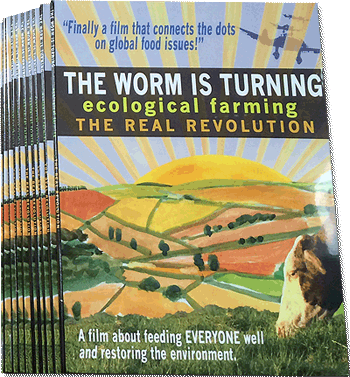
The Worm is Turning, documentary, directed by Hilary Bain, 2016
This documentary focuses on how modern farming using harmful chemicals was spread from the West to Asia, using India as an example. The film looks at the health problems for humans and the environment, as well as the globalisation of this agriculture, from the ‘first world’ to the rest of the world. People interviewed include Vandana Shiva, Joel Salatin, and New Zealand’s own Meriel Watts. There are magnificent examples of farmers in the East and the West (such as those featured in this article), who demonstrate the possibility of sustainable, ecological farming systems, backed by an informed and supportive public, so the world’s farmers can farm as if the future mattered!
• Watch online for a small fee
• Buy the DVD or ask your organic shop to stock it
• Organise a screening for your friends, club or workplace: buy a screening licence.
Hilary Bain was born in Zimbabwe and spent most of her life in California, watching and supporting the rise of one of the first organic farming movements. She’s an artist concerned with the relationship between the powerful and the powerless. She currently resides in Australia.